


Chapter 5 - Section 5.4Joint Liability Group Financing: Complementing the SHG-Bank Linkage Channel
Joint Liability Group (JLG) financing is an important complementary channel within India’s broader microfinance architecture. Cumulatively, JLGs credit-linked stood at 423.9 lakh as on 31 March 2026, registering year-on-year growth of 11.33%, with cumulative loans disbursed reaching ₹7,74,610 crore.

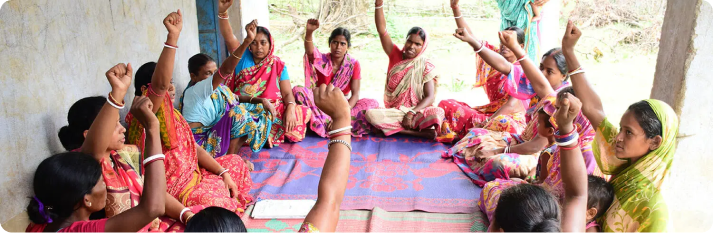
SHG-Bank Linkage Programme: Moving from Financial Inclusion to overall wellbeing
5.4 Joint Liability Group Financing: Complementing the SHG-Bank Linkage Channel
Joint Liability Group (JLG) financing is an important complementary channel within India’s broader microfinance architecture. While the SHG-Bank Linkage Programme is savings-led and built around group mobilisation, internal lending and collective financial management, the JLG model is primarily a credit-led mechanism designed to improve access to formal loans for individuals who may lack conventional collateral, documented land titles or a prior banking relationship. JLGs are particularly relevant for small and marginal farmers, tenant farmers, sharecroppers, oral lessees, landless cultivators, livestock rearers and other rural producers engaged in livelihood activities.
Under the JLG model, a small group of individuals with similar economic activities or livelihood interests accesses credit on the basis of mutual guarantee and joint liability. The model enables members to access loans individually or collectively, while peer accountability substitutes for conventional collateral. It can therefore help formal lenders reach borrowers who are otherwise excluded from institutional credit because of informal tenancy arrangements, limited asset ownership or inadequate documentation.
The JLG channel should be viewed as distinct from, rather than interchangeable with, the SHG-Bank Linkage Programme. SHGs generally build financial discipline through regular savings, internal lending and collective decision-making before accessing bank finance. In contrast, JLGs are primarily formed to facilitate credit access for economically active individuals, particularly in agriculture and allied sectors. The two models serve different, but overlapping, segments of financially excluded households
NABARD initiated a pilot project for financing Joint Liability Group (JLG) of landless and tenant farmers in 2004-05, primarily to provide a platform for credit linkage for such farmers. Since 2009-10, alongside providing refinance support to banks, NABARD has been awarding grant assistance to banks and eligible agencies (JLG Promoting Institutions, or JLGPIs) to support the formation, nurturing and capacity building of JLGs and their stakeholders.
Figure 5.9: No. of Credit-Linked JLGs (cumulative, in Lakh)
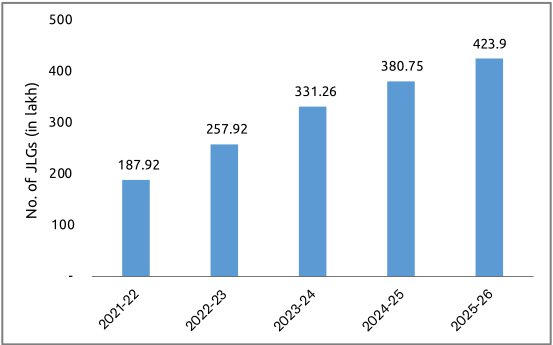
Figure 5.10: Credit Disbursed to JLGs (cumulative, ₹ in crore)
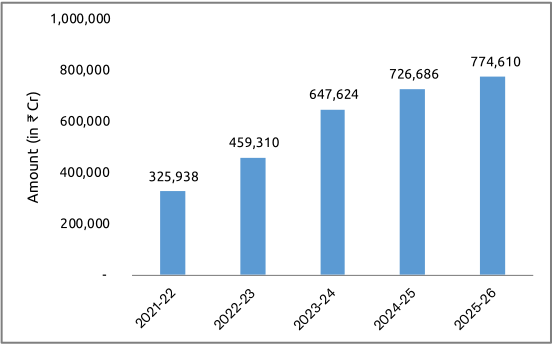
Cumulatively, JLGs (all JLG including MFI JLGs financed by banks) credit-linked stood at 423.9 lakh as on 31 March 2026, registering year-on-year growth of 11.33%, with the Southern and Eastern regions recording the highest absolute growth. Cumulative loans disbursed to JLGs by banks reached ₹7,74,610 crore, an increase of 6.59% from ₹7,26,686 crore as on 31 March 2025.
Box 5.1: MFI Accelerator Programme (MAP): A focused initiative of NABARD for strengthening smaller Microfinance Institutions
The MFI Accelerator Programme is a mentor led capacity building initiative conceptualised by NABARD with the help of Sa-Dhan (MFI SRO recognised by RBI) as a pilot initiative to strengthen identified 21 smaller MFIs operating in rural and underserved regions. The programme seeks to help participating MFIs graduate to the next level of institutional maturity by enhancing their governance systems, technology adoption, operational efficiency, risk management practices, human resource capabilities, regulatory compliance, and access to funding.
Through a structured model of training, mentoring, baseline assessments, and performance tracking, the programme provides customized support to MFIs to address specific institutional gaps and improve their sustainability and outreach. By strengthening the capabilities of smaller MFIs, the programme aims to expand responsible financial services to underserved communities, promote financial inclusion, and support livelihood generation and inclusive rural development.
The pilot aims to strengthen 21 select MFIs with an Asset Under Management (AUM) ranging from ₹10 crore to ₹500 crore, particularly those having at least 50% rural borrowers, satisfactory repayment performance and past record of profitability. Participating institutions undergo an extensive diagnostic assessment to identify areas of interventions. Based on the findings, a tailored development roadmap is prepared for each MFI, supported by mentors from the MFI industry who guide institutions in improving governance frameworks, strengthening risk controls, enhancing digital capabilities, diversifying products, and improving operational sustainability. The programme also facilitates knowledge sharing on regulatory developments, emerging technologies, customer protection principles, and best practices in sustainable microfinance.
Quick Insights from Baseline Survey
- The participating MFIs were found to be broadly compliant and operationally stable, with strengths in formalisation, board functioning and financial performance.
- Around 71% of MFIs were assessed in the medium-risk category and 29% in the high-risk category.
- Key gaps were observed in governance depth, risk systems, HR capacity, digital integration and operational efficiency.
- Financial sustainability was found to be under pressure due to high cost of funds and elevated cost-to-income ratios.
Courtesy: National Bank for Agriculture and Rural Development (NABARD)