


Chapter 4 - Section 4.4 - SubSection 4.4.3Profitability Ratios
Analysing Return on Assets (RoA) and Return on Equity (RoE) is important for assessing how effectively MLIs are using their capital to build better quality assets and wealth for investors. Together, these measures provide a broader view of profitability and financial sustainability, particularly when considered across portfolio size-wise.


Return on Assets (ROA) and Return on Equity (ROE) of MLI: Size-wise
4.4.3 Profitability Ratios
Analysing Return on Assets (RoA) and Return on Equity (RoE) is important for assessing how effectively MLIs are using their capital to build better quality assets and wealth for investors. Together, these measures provide a broader view of profitability and financial sustainability, particularly when considered across portfolio size-wise.
Figure 4.4.4: Return on Assets (ROA) and Return on Equity (ROE) of MLI: Size-wise
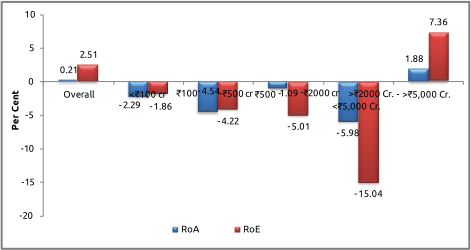
The relationship between institution size and RoA/RoE provides an important perspective on how scale is translating into profitability and returns on the capital employed. When viewed alongside the surplus position of MLIs, the distribution shows a clear differentiation between larger and smaller institutions.
The return profile closely reflects the surplus position across size categories. MLIs with AUM below ₹2,000 crore recorded negative RoA and RoE, indicating that the negative surplus reported among these segments translated into weaker returns on both assets and equity. The ₹2,000–₹5,000 crore category recorded the weakest performance, with RoA of -5.98% and RoE of -15.04%, pointing to significant profitability and capital-efficiency pressures. In contrast, Larger MLIs with AUM above ₹5,000 crore recorded positive RoA of 1.88% and RoE of 7.36%, consistent with their substantially stronger surplus position. The pattern suggests that scale is an important factor in the sector’s ability to absorb operating and financial costs and generate sustainable returns, with profitability increasingly concentrated among the largest institutions — the same institutions that, per Section 4.3, have captured the bulk of the benefit from the RBI’s recent rate cuts.
Box 4.4.1: Digital Collections through UPI: Modernizing Rural Loan Repayments
SATYA’s UPI-enabled collections are transforming the repayment experience for rural borrowers by making repayments more convenient, secure, and efficient. Through client-specific UPI QR codes, borrowers can make repayments directly from their mobile phones, reducing the need for cash handling, travel, and dependence on field officers. The introduction of UPI Autopay has further strengthened the initiative by enabling recurring repayments and promoting timely payments and financial discipline.
The initiative recorded more than ₹1,500 crore in cashless collections during FY 2025–26 across 26 States and Union Territories, reflecting the growing acceptance of digital payments in rural and semi-urban areas. Cashless collections have reduced risks related to theft, fraud, errors, and cash logistics, while enabling field staff to focus more on client engagement and financial literacy.
For rural women entrepreneurs, digital repayments have also emerged as an important tool for financial inclusion and empowerment. By using UPI, QR codes, mobile banking applications, and digital wallets, borrowers are gaining confidence in participating in the formal digital financial ecosystem. The initiative also supports sustainability by reducing paper usage and the environmental footprint associated with cash-based transactions.
With a vision to expand adoption to 10 million households by 2030, SATYA’s UPI-enabled collections demonstrate how technology, customer-centricity, and financial inclusion can come together to make rural finance more accessible, sustainable, and empowering.
Key Impact:
- Greater convenience & security through UPI-based, cashless repayments.
- Timely repayments enabled by UPI Autopay, supporting financial discipline.
- Improved field efficiency and greater focus on client engagement.
- Enhanced digital and financial inclusion, especially among rural women.
- Reduced paper use and cash-handling risks, supporting sustainability.
- Target: Reach 10 million households by 2030.
Courtesy: Satya MicroCapital Ltd.
Conclusion
The microfinance institutions can survive only if they have profitable operations. They should be able to have Operational Self-Sufficiency and also generate adequate income to have a positive ROA and ROE. This can only attract more investment in the sector, which will benefit the poorer households directly. The sector’s financial performance in FY2025-26 reflects a mixed but gradually improving picture, on the whole. But granular analysis indicates that this positiveness is due to the performance of larger institutions rather than a sector-wide phenomenon. It is very clear that the sector is in a growth phase which has to be supported by funds. If funds are made available, even smaller ones can perform positively and record better profitability ratios.
The analysis has shown that the larger MLIs demonstrated stronger capacity to absorb costs and generate returns, while several smaller and mid-sized institutions continued to face pressure on profitability, RoA and RoE. The analysis also indicates that higher loan size translates into better operating efficiency. Whereas such a correlation is not there with yield. Going forward, cost optimisation, productivity improvement, prudent growth and stronger financial management will remain important for strengthening the sustainability and resilience of MLIs, particularly if the current, unevenly distributed tailwind from lower funding costs does not persist or does not reach smaller institutions in time.