


Chapter 4 - Section 4.5 - SubSection 4.5.2.iiEquity Outstanding
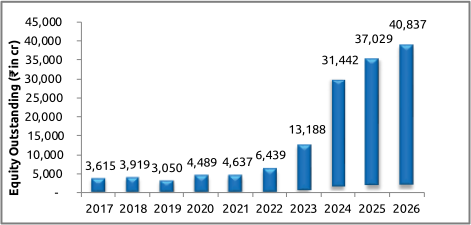
The microfinance sector’s equity base has expanded substantially over the past decade, indicating a significant strengthening of its capital base. Equity outstanding increased from ₹3,615 crore in 2017 to ₹40,837 crore in 2026, representing more than an eleven-fold increase. After fluctuations during 2017–21, equity growth accelerated significantly from ₹6,439 crore in 2022 to ₹13,188 crore in 2023, then rose further to ₹31,442 crore in 2024. The momentum continued in 2025 and 2026, with equity reaching ₹37,029 crore and ₹40,837 crore, respectively.


MLI Equity Outstanding - Yearly Trend
MLI Equity Outstanding - MLI-Category-wise Break-up of March 2026 (Legal Form)
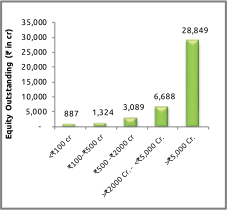
MLI Equity Outstanding - MLI-Category-wise Break-up of March 2026 (Portfolio Size)
4.5.2.ii Equity Outstanding
The microfinance sector’s equity base has expanded substantially over the past decade, indicating a significant strengthening of its capital base. Equity outstanding increased from ₹3,615 crore in 2017 to ₹40,837 crore in 2026, representing more than an eleven-fold increase. After fluctuations during 2017–21, equity growth accelerated significantly from ₹6,439 crore in 2022 to ₹13,188 crore in 2023, then rose further to ₹31,442 crore in 2024. The momentum continued in 2025 and 2026, with equity reaching ₹37,029 crore and ₹40,837 crore, respectively.
The sharp increase since 2023 suggests greater capital mobilisation and stronger institutional balance sheets, potentially supporting portfolio expansion, regulatory compliance, and the provision to absorb credit and operational losses. The more moderate growth in 2026, compared with the exceptionally large increases in 2023–25, may indicate a shift towards consolidation after significant capital strengthening. A stronger equity base also provides institutions with greater resilience amid portfolio-quality pressures and rising operating costs, while creating additional capacity to leverage external funding for sustainable growth. Overall, the sustained increase in equity indicates improved capital depth and financial resilience across the sector.
The distribution of equity outstanding shows a strong concentration among larger institutions and NBFC-MFIs, reflecting their scale and capital requirements. By portfolio size, institutions with portfolios above ₹5,000 crore account for ₹28,849 crore of equity, representing more than 70% of the sector’s total equity base. This is followed by institutions in the ₹2,000–5,000 crore category with ₹6,688 crore, while the ₹500–2,000 crore segment accounts for ₹3,089 crore. Smaller institutions have a relatively limited equity base, with ₹1,324 crore for the ₹100–500 crore category and ₹887 crore for institutions below ₹100 crore.
Figure 4.5.3: MLI Equity Outstanding - Yearly Trend and MLI-Category-wise Break-up of March 2026
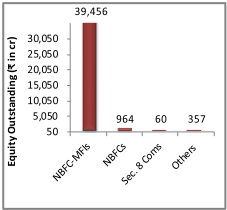
A similar concentration is evident across legal forms, with NBFC-MFIs accounting for the overwhelming majority of equity outstanding, while NBFCs1, Section 8 companies and other institutions hold comparatively small amounts. This concentration largely reflects NBFC-MFIs’ dominant share in the sector and their greater ability to attract institutional and external capital. Larger institutions’ stronger equity position gives them greater loss-absorption capacity, scope to leverage additional borrowings, and flexibility to support future portfolio growth. Conversely, the relatively smaller capital base of smaller MFIs may constrain their ability to scale and absorb periods of financial stress, highlighting the importance of strengthening diversified equity capital.
1 This analysis excludes some of the larger NBFCs like L&T and Bajaj, which have provided the self-reported data partially.
Fresh Equity Acquired
Equity mobilisation is an important indicator of the sector’s ability to attract fresh capital and strengthen its financial capacity. New equity gives institutions additional capital to support portfolio growth, absorb potential losses, meet regulatory requirements, and invest in technology, risk management, and operational infrastructure. Examining equity raised during the year, across legal forms and institutional size, provides insight into capital access, investor confidence and the capacity of different segments to support future growth.
Figure 4.5.4: Fresh Equity Raised by MLIs and MLI-Category-wise Break-up
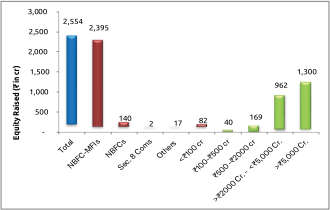
Equity raised in 2026 was ₹2,554 crore, with an overwhelming ₹2,395 crore (94%) mobilised by NBFC-MFIs, highlighting their dominant role in attracting fresh capital to the sector. NBFCs raised ₹140 crore, while Section 8 companies and other institutions together accounted for only a small share, which is expected as the nature of their operations more towards non-profit in nature. By portfolio size, equity mobilisation was strongly concentrated among larger institutions: entities with portfolios above ₹5,000 crore raised ₹1,300 crore, followed by those in the ₹2,000–5,000 crore category with ₹962 crore. Together, these two segments accounted for around 89% of total equity raised. In comparison, institutions below ₹2,000 crore collectively raised only ₹291 crore. This concentration suggests that larger institutions continue to have stronger access to equity capital, potentially supported by their scale, established track record, investor confidence and greater capacity to deploy additional capital. For smaller and mid-sized institutions, limited equity mobilisation may constrain their ability to strengthen capital buffers and expand portfolios, underscoring the importance of improving access to long-term and patient capital across the sector. In this regard, there is a need for public capital like IMEF in larger quantities. This will help the smaller institutions to grow bigger and become stronger to extend financial intermediation support to the poor.