


Chapter 1.2The External Environment, Climate and the Rural Household
The macroeconomic backdrop was favourable. It was not calm. Three external developments defined the period: the reordering of global trade, energy price volatility, and currency movement. What is notable is how well the external account absorbed all three — the external environment was turbulent; the external position was not.

Indian Microfinance: Resilience, Responsibility & Inclusion Ramesh Srivatsava Arunachalam
1.2 The External Environment, Climate and the Rural Household
The macroeconomic backdrop was favourable. It was not calm. The geopolitical issues also added to the misery. Three external developments defined the period. The first was the reordering of global trade, with the United States announcing a blanket tariff together with country-specific levies in April 2025; India responded by widening its trade relationships, and the merchandise trade deficit widened to approximately US$333 billion in FY2025-26 from US$283 billion.12 The second was energy price volatility, which reaches the microfinance household by two direct routes: fuel is a disproportionate cost line for the transport-linked microenterprise, and energy prices feed agricultural input costs through diesel and fertiliser. The third was currency movement, with the rupee depreciating by approximately 5.4 per cent against the US dollar between April 2025 and January 2026, which raises the rupee cost of imported edible oil, fertiliser and energy, raises the cost of external commercial borrowings, and raises the rupee value of every remittance received.13
What is notable is how well the external account absorbed all three. For FY2025-26 as a whole, the current account deficit settled at US$25.2 billion, or 0.6 per cent of GDP, against US$22.9 billion and the same 0.6 per cent a year earlier, with the fourth quarter recording a surplus of US$7.1 billion.14,15 Foreign exchange reserves stood at approximately US$701 billion in January 2026, covering around eleven months of imports, and net services exports grew 15.3 per cent during April–December 2025.16,17 The external environment was turbulent; the external position was not.
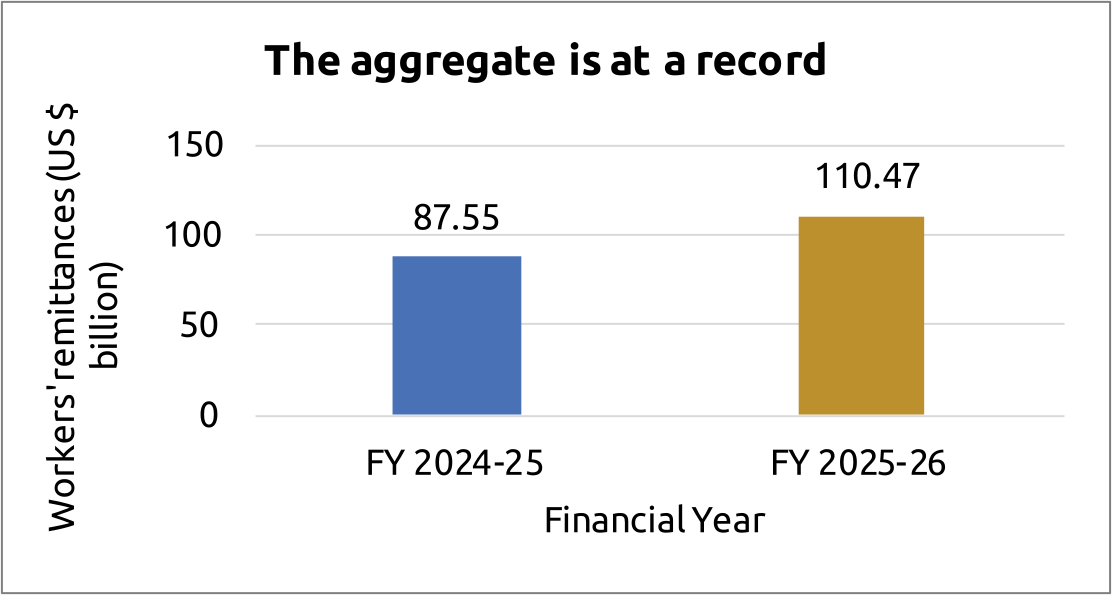
Remittances deserve separate treatment, because the picture that matters for microfinance is not the one the headline conveys. India remained the world’s largest recipient, and workers’ remittances rose to US$110.47 billion in FY2025-26 from US$87.55 billion the previous year.18,19 Beneath that aggregate sits a structural shift of direct consequence: the share originating in the Gulf Cooperation Council countries fell from 46.7 per cent in 2016-17 to 37.9 per cent in 2023-24, while the share from advanced economies rose.20 The Gulf corridor is the low-skilled, high-volume migration route, and it feeds precisely the eastern and northern districts where borrower density is highest. The sector therefore faces an unusual configuration: national remittances at a record, and the particular flow that reaches the microfinance household growing more slowly than the total. Figure 1.4 sets out both facts together.
Figure 1.4: Record remittances, shifting corridors21
(Total workers’ remittances and the Gulf share of inflows to India)
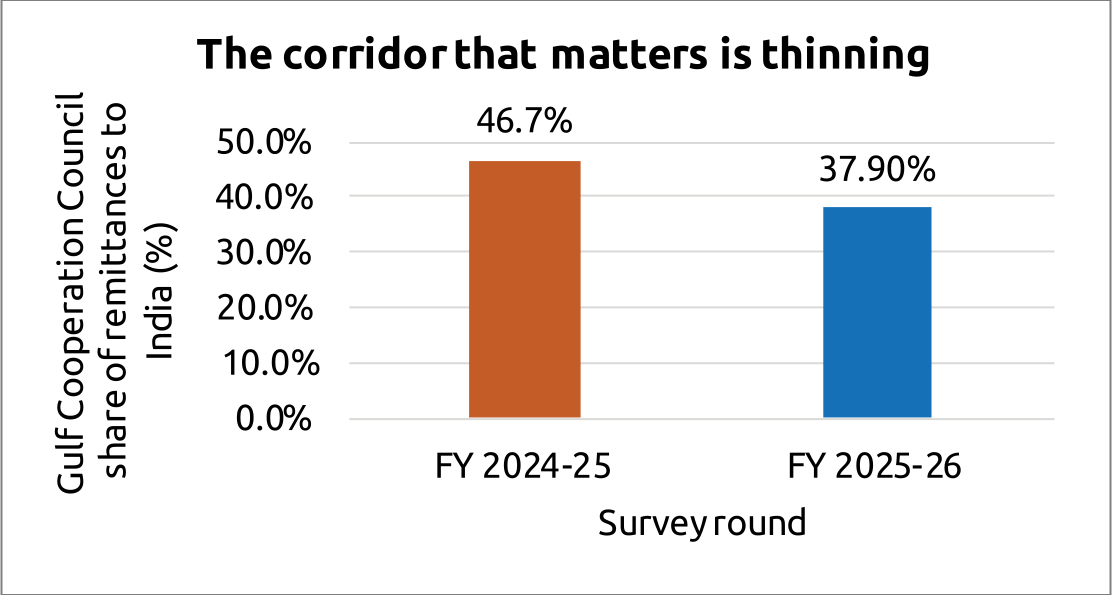
Gulf migration feeds the eastern and northern states where microfinance density is highest.
The practical instruction is that a lender operating in Bihar, Uttar Pradesh, Odisha or Jharkhand should treat Gulf labour-market conditions as a portfolio variable, not as foreign news. Remittance flows into a source district are observable now that transfers run on instant payment rails, and a district-level remittance indicator would give a genuine forward signal on household liquidity.
Trade, currency and remittances reach the household through prices and transfers. The next factor reaches it through the harvest itself, and it is the one the sector is least able to diversify away. Climate variability remains the most serious medium-term risk, and it has a property that distinguishes it from every other risk in a microfinance portfolio. Ordinary credit risk is idiosyncratic, and the group model diversifies it away; a climate event is covariate, affecting every borrower in a district simultaneously. Rising frequency is a concern; rising spatial correlation is a structural challenge to the risk model itself. Through 12 August 2026, cumulative rainfall ran 12 per cent below the long-period average, with the eastern and north-eastern region the region of highest borrower density — carrying a materially larger shortfall than the national figure conveys.22 The policy architecture has strengthened through crop insurance, the agricultural data stack and the restructured rural employment guarantee, whose allocation was raised by approximately 42.8 per cent over the revised estimate, a decision whose timing, ahead of a below-normal forecast, is worth noting.23
Climate determines rural household income in a bad year; the labour market determines it in an ordinary one. Open unemployment alone can be misleading because rural India often absorbs surplus labour through agriculture. In 2025, rural unemployment was 2.4%, but short-term and seasonal joblessness was much higher, making it more relevant for borrowers with frequent repayments.
Four indicators matter: the gap between usual- and weekly-status unemployment; agriculture’s 58.5% share of rural employment; youth unemployment of 9.9%, with 24.9% not in employment, education or training; and rising unpaid family work. Together, these suggest that low rural unemployment does not necessarily mean strong or stable household earning capacity—an important consideration for microfinance underwriting and repayment assessment.
Set out factor by factor, the pattern is unmistakable: almost every external and climatic line reverses between the two years. That is the substance of this paper’s argument. The sector’s difficulty in FY2024-25 and its recovery in FY2025-26 were driven substantially by the same set of channels moving first in one direction and then in the other. Sector-level discipline determined how well the institutions came through it. The channels determined what they had to come through. Table 1.2 sets out each external and climatic factor, the channel it travelled through, and its direction in each of the two years.
Table 1.2: External and climatic factors, and how they reached the microfinance household
| Factor | Channel | Direction, FY2024-25 | Direction, FY2025-26 |
|---|---|---|---|
| Global trade reordering and tariffs | Growth and income | Adverse: investment uncertainty | Absorbed; trade relationships widened |
| Crude and energy prices | Inflation; rural and agricultural | Adverse: input and transport costs | Favourable for most of the year, firming late |
| Fertiliser and farm input costs | Rural and agricultural | Adverse: margin compression at the farm gate | Eased alongside energy and a record harvest |
| Rupee depreciation | Inflation; monetary and financial | Mixed: import costs up, remittance value up | Mixed, with remittance value gain dominant |
| Remittances, aggregate | Growth and income | Supportive | Strongly supportive; record inflows |
| Remittances, Gulf corridor | Growth and income | Structurally thinning as a share | Continues to thin; a forward risk |
| Monsoon and agricultural output | Rural and agricultural; climate | Adverse in parts; uneven farm income | Strongly favourable; record output |
| Climate covariate events | Climate and shock | Adverse and locally severe | Contained; buffers intact, weaker season forecast |
| Rural labour market | Growth and income | Adverse: real wages compressed by inflation | Favourable: real wages gained from near-zero inflation |