


Chapter 3 - Section 3.5Distribution of Loans by Purpose
Under the current regulatory framework, RBI has not prescribed any proportion for income-generating and non-income-generating lending. MLIs have, however, broadly retained the lending pattern followed earlier.


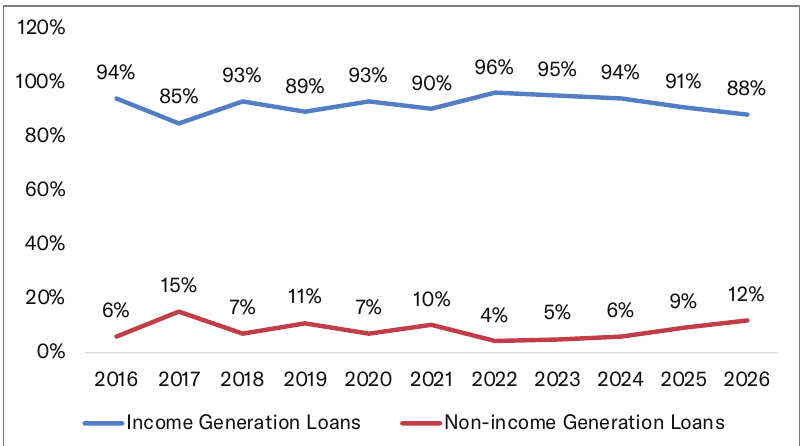
Share of MLIs’ Income Generation Loans and Non-income Generation Loans
3.5 Distribution of Loans by Purpose
Under the current regulatory framework, RBI has not prescribed any proportion for income-generating and non-income-generating lending. MLIs have, however, broadly retained the lending pattern followed earlier.
Self-reported data indicate that borrowers use loans for a range of purposes. A majority of lending is directed towards income-generating activities such as agriculture, animal husbandry, trading and agro-enterprises. Loans are also used for non-income-generating purposes, including consumption, housing, education, water and sanitation, and health.
Figure 3.8 presents the distribution of lending between income-generating and non-income-generating purposes. Within income generating segment, Agriculture accounts for the largest share at 41%, followed by animal husbandry (18%), and trading (14%). Within the non-income-generating segment, the principal uses are housing, education, water and sanitation, consumption and health-related expenses.
The RBI’s recent guidelines on the reduction of qualifying asset criteria for NBFC-MFIs from 75% to 60% open up significant opportunities for the NBFC-MFIs, especially to diversify their portfolios and strengthen financial resilience. A more diversified portfolio will allow the NBFC-MFIs to better manage sector-specific shocks, such as natural disasters or socio-political disruptions that disproportionately affect low-income microfinance borrowers. By shifting a portion of lending toward less volatile segments, the NBFC-MFIs can minimise credit losses and sustain earnings across cycles. However, most of the MLIs are following a cautious approach to this new facility.
Figure 3.8: Share of MLIs’ Income Generation Loans and Non-income Generation Loans
3.5.1 Types of Income Generation Loans and their respective share
Figure 3.9: Share of MLIs’ Income Generation Loans under Different Sub-sectors as of March 2026
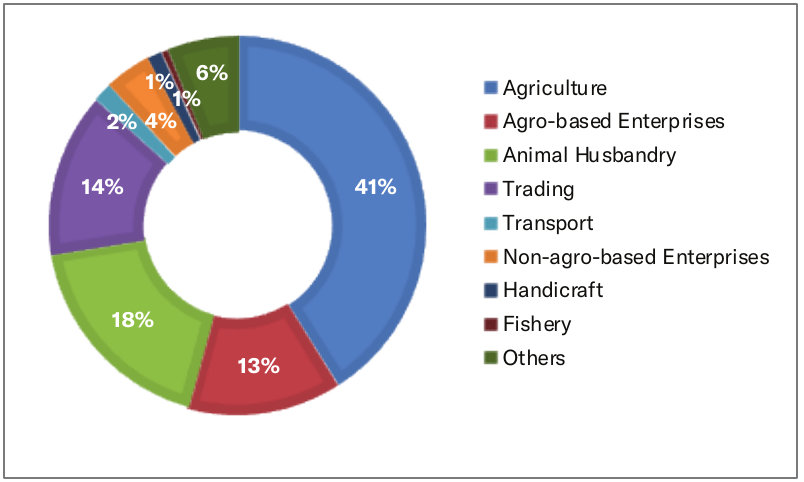
Figure 3.9 presents the distribution of income-generating loans across major sub-sectors. Agriculture accounts for the largest share at 41%, followed by animal husbandry at 18% and trading at 14% of the income-generating loan portfolio.
3.5.2 Types of Non-Income Generation Loans and their respective share
Figure 3.10: Share of MLIs’ Non-Income Generation Loans under Different Sub-sectors as of March 2026
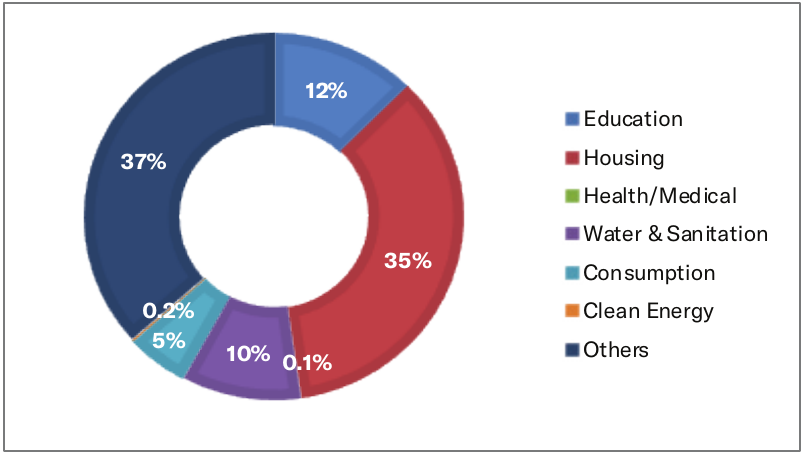
Figure 3.10 shows that housing accounts for a major share of non-income-generating loans at 35%. The remaining 65% is allocated to education, consumption, health and medical needs, water and sanitation, clean energy and other purposes. These uses address essential household needs and may support household resilience and longer-term well-being.
Note: Although there could be some variance in the actual purpose for which borrowing is done, it still gives us some idea and trend as to how the funds are used by the microfinance borrowers.
Box 3.1: Data-Driven Operational Risk Assessment Framework for Risk-Based Branch Supervision in Microfinance
To ensure consistent control standards and strengthen operational resilience across its expanding branch network, Midland Microfin Limited implemented a structured Data-Driven Operational Risk Assessment Framework that evaluates every branch on a monthly basis using predefined operational risk indicators. The framework assesses portfolio quality, governance, operational controls, fraud exposure, people risk, customer protection, audit observations, and process compliance, and classifies branches into High, Medium, or Low Risk categories.
By transforming operational data into actionable risk intelligence, the framework enables early identification of emerging vulnerabilities, supports risk-based supervision, and facilitates timely management intervention. Acting as an enterprise-wide Early Warning System (EWS), it drives targeted supervisory actions, focused audits, and corrective measures for higher-risk branches while optimising the allocation of supervisory resources in line with each branch’s risk profile.
IT-Enabled Operational Enhancements (FY 2025–26)
To complement the risk framework, Midland Microfin Limited upgraded its Loan Origination System (LOS) with advanced technological controls:
- API-Based Disbursement Controls: Introduced disbursement amount/loan count visibility and OTP-based authorization via SMS/Email to secure batches and improve governance.
- Credit Workflow & Data Validation: Integrated enriched Credit Bureau summaries (incorporating PAN, Voter ID, phone numbers, and addresses), borrower matching analytics, and robust expense validation controls.
- OCR-Based KYC Verification: Digitized document verification and KYC/bank document access to reduce manual work, accelerate customer onboarding turnaround times, and boost compliance accuracy.
Key Benefits & Strategic Outcomes
- Continuous Monitoring: Monthly risk assessments enable early detection of operational vulnerabilities before they escalate.
- Risk-Based Supervision: Supervisory visits, internal audits, and management oversight are dynamically allocated based on each branch’s risk profile, intensifying focus on High-Risk locations while maintaining routine checks on Low-Risk branches.
- Enhanced Governance: Structured dashboards provide senior management with real-time risk visibility, supporting data-driven decisions and accountability.
- Strengthened Risk Culture: Transparent categorisation encourages operational teams to strictly adhere to internal controls and risk management practices.
By combining data-driven branch risk assessments with robust IT enhancements, Midland Microfin Limited has successfully transitioned from reactive monitoring to a proactive, risk-based supervision model, optimising resources, reinforcing operational resilience, and safeguarding customer interests.
Courtesy: Midland Microfin Ltd.